Argyles & Fair Isles


The &Daughter Guide to Argyles & Fair Isles
Argyle and Fair Isle are patterns that are rooted in the textile heritage we build the whole brand around,” says Buffy Reid, founder of &Daughter. "Scotland is the home of argyle, and also where our knitwear is made, so it has always been part of the &Daughter story." The tradition of Fair Isle and argyle knits are as entwined with Scottish heritage as &Daughter’s own history. These two classic colourwork patterns stand for heritage style, and as a brand with its roots in celebrating and supporting traditional makers, argyle and Fair Isle have been a natural inclusion within our collections from the very beginning.


Heritage Through A Modern Lens
We’ve moved away from more traditional heritage palettes towards richer, sometimes unexpected combinations, and played with the scale of both the pattern and the garment,” says Buffy. The overall approach is one inspired by tradition, respectful of origins, but reimagined through a modern lens.

Origins
The tradition begins with the yarn. Our wool and cashmere yarns are spun by Todd & Duncan, at their Scottish mill on the shores of Loch Leven, operating since 1867. Set within a nature reserve of wetlands, and a vital breeding ground for birds, the mill draws the pure, soft waters from the loch to wash its yarn, essential to the quality and hand-feel of the resulting product. Ninety miles away is Hawick, a Scottish border town of heather hills, and another outpost of the Scottish knitwear tradition. Here, in a small family mill, &Daughter’s argyles and Fair Isles are made, using age-old techniques and in the hands of makers who have had the tradition passed down to them through generations.


Artisanal Craft
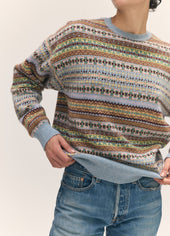
The argyles use an intarsia technique, a slow approach to knitting with a luxurious result: unlike jacquard, the colours are changed frequently across each row to create the distinctive pattern, but without adding weight to the knit. Meanwhile Fair Isle features two colours per row, with the yarns carried across the back of the knit, a stranded technique which also adds warmth to the finished piece.

History
The history of both techniques begins in Scotland, with Fair Isle named for the Shetland island where it likely originated in the 19th century. Argyle, meanwhile, may go back as far as the 17th century, possibly originating as a way to make tartan more form-fitting.
Both became popular in the 1920s, when not only was the Prince of Wales (later Edward VIII) pictured wearing a Fair Isle sweater for a game of golf at St Andrews in 1921, but Gabrielle “Coco” Chanel began visiting the Highlands, and became interested in traditionally masculine clothing worn for outdoor pursuits, with Scottish textiles, including knitwear, making their way into all of her collections. This played no small part in the pattern’s popularity, resulting in clear associations with aristocratic style codes as well as finding favour with Hollywood stars such as Katharine Hepburn and Grace Kelly.


Worn (And Loved) Today
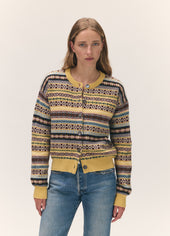
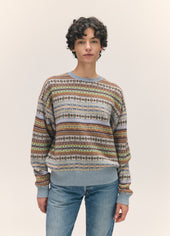
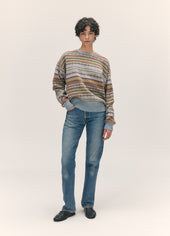
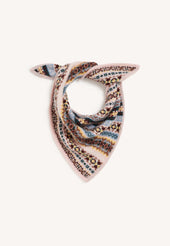
With tradition as the basis, &Daughter’s argyles and Fair Isles play with proportion, scale and colour to create something entirely new each season. While the foundational techniques of argyle and Fair Isle will always find a place in the collection, fresh colours and new silhouettes mean there is always a new take. The Ava Argyle Crewneck features an almost acid green punctuating stripe, set against classic navy and burgundy. The Ada Fair Isle cardigan is based on a lemon yellow palette and features a slouchy, modern shape; a foulard features a Fair Isle in cashmere and is tied at the neck to be worn with a T-shirt. Each piece finds its place among relaxed denim or well-cut T-shirts as a key piece of a modern wardrobe.
SHOP NOW
View all-
-
New In
Innes Slouch Fair Isle Crewneck in Vintage Multi
Regular price £475.00Regular priceUnit price perAvailable colours


-
New In
-